
In the world of software engineering, developers are commonly categorized into three broad levels of seniority: Junior Developers, Mid-Level Developers, and Senior Developers.
However, one question frequently arises among both aspiring and experienced programmers:
What criteria determine a developer’s level of seniority?
Does mastering more tools automatically make someone a senior developer? Can years of experience alone define seniority? Or perhaps the number of completed projects?
The truth is that answering these questions requires a much broader discussion. In this article, I would like to share some insights based on years of personal experience, along with concepts drawn from well-known competency models used in software engineering.
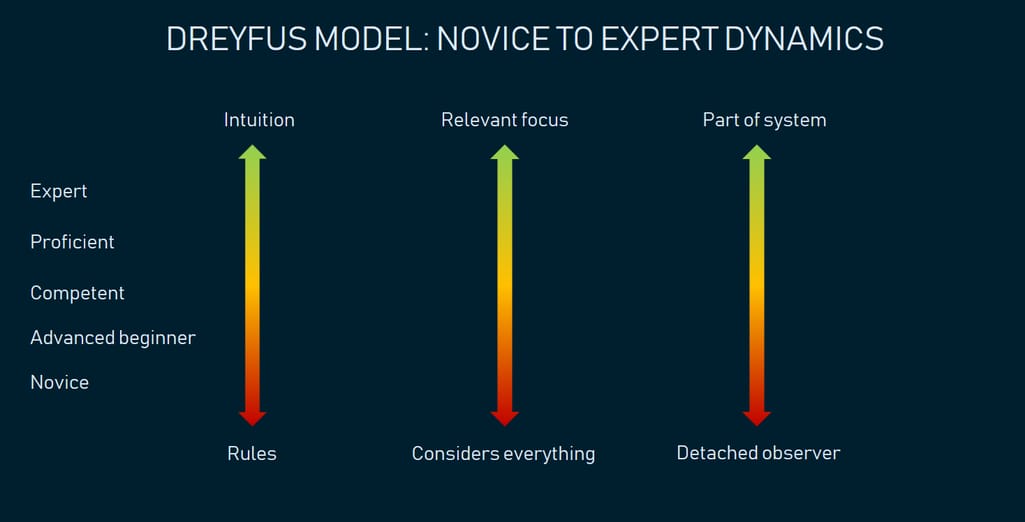
Dreyfus model of skill acquisition
One of the scientific frameworks used to evaluate skill development across different disciplines is the Dreyfus Model of Skill Acquisition.
This model describes five stages of learning and expertise development. Although it is not limited to software engineering, author Andy Hunt adapted the Dreyfus model to software development to better explain how programmers evolve in their professional journey.
In software engineering, the model suggests that developers progress through different stages as they gain technical depth, practical experience, problem-solving ability, and business understanding.
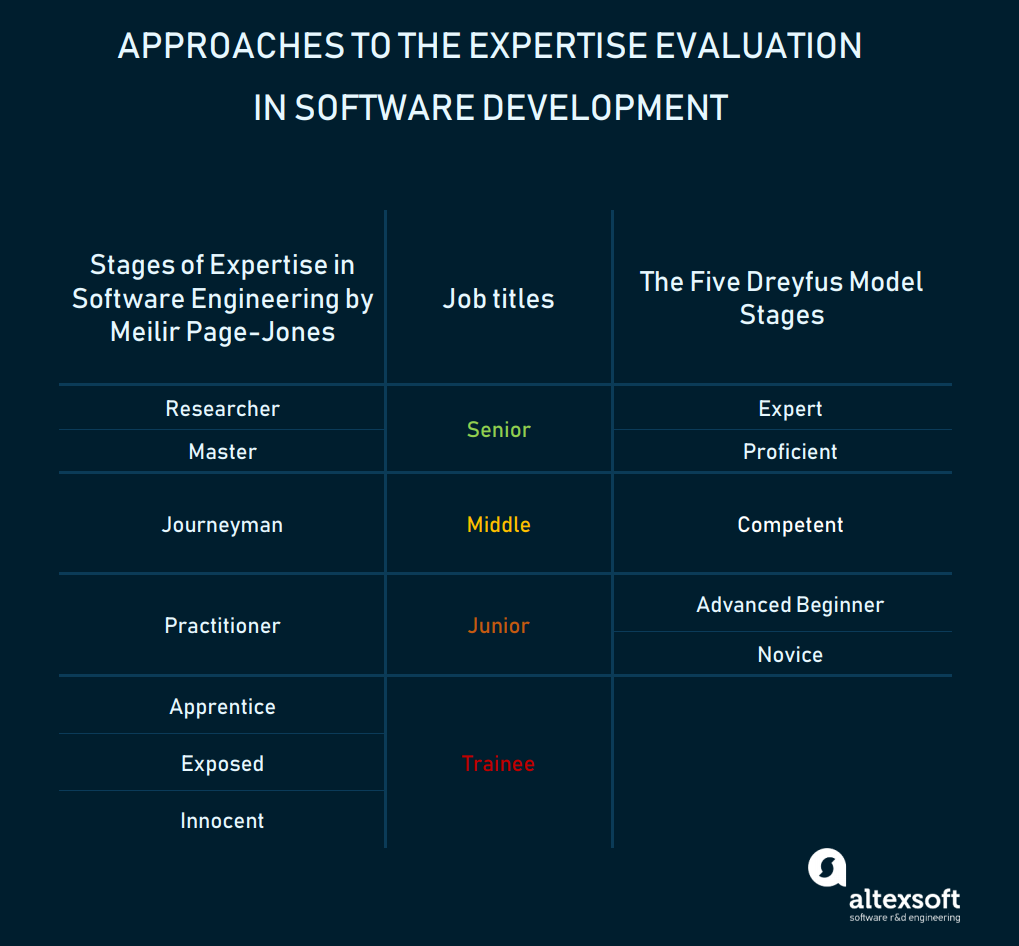
Another model inspired by the Dreyfus framework is the Programmer Competency Matrix, designed by Sijin Joseph.
Unlike the Dreyfus model, which presents a broader view of expertise development, the competency matrix divides developer expertise into seven levels of proficiency.
While these charts and matrices require deeper explanation, let us briefly review the most common career progression path for software developers.
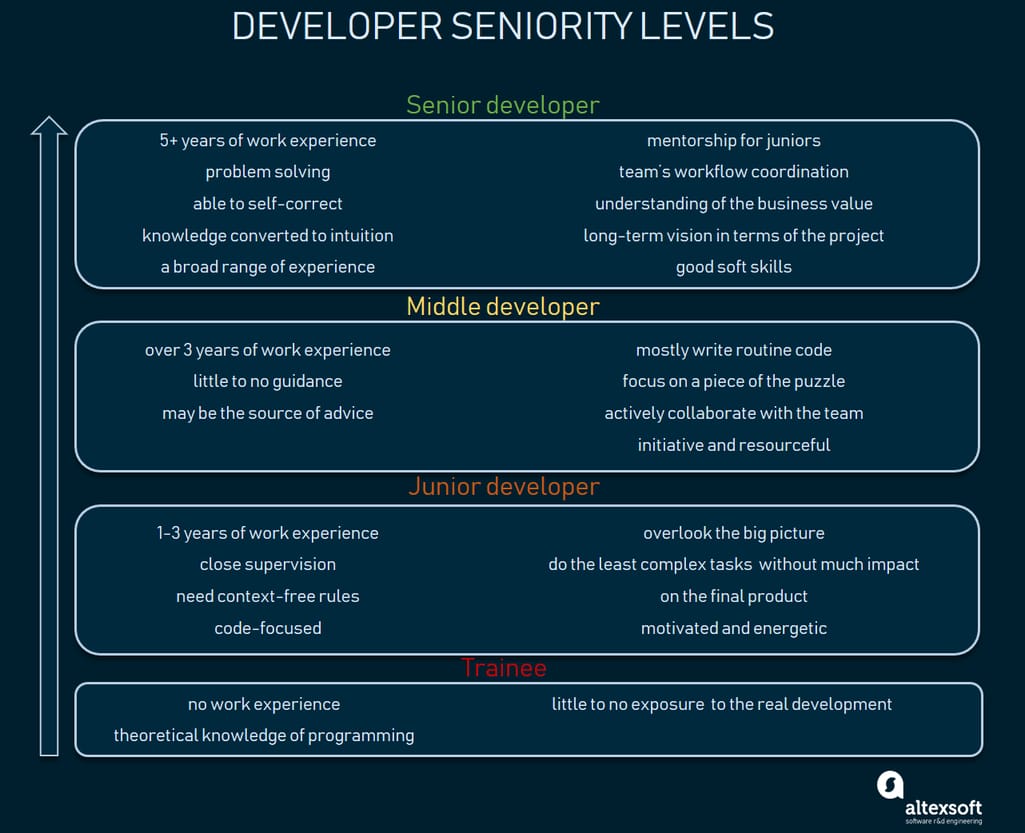
At the entry level, we have the Trainee Developer.
A trainee is usually someone with a general understanding of programming languages and databases but limited hands-on experience. Their role is often observational, while repetitive or low-risk tasks may be delegated to them to save time for more experienced developers.
Most trainees are recent university graduates with little to no professional experience.
The next stage is the Junior Developer.
Junior developers typically focus more on technical implementation rather than business logic or domain understanding. Their work often revolves around tools and technologies such as:
A junior developer generally has one to three years of professional experience.
At this stage, developers are still learning best practices, debugging techniques, collaboration methods, and structured software development approaches.
After gaining sufficient experience, developers usually transition into the Mid-Level Developer role.
Mid-level developers are more independent and often begin mentoring junior developers. They generally possess three to five years of professional experience and work more closely with senior engineers.
At this stage, developers are expected to:
They are no longer simply writing code—they are contributing to technical decision-making.
Finally, we arrive at the Senior Developer level.
A senior developer is not merely someone who writes better code. More importantly, they are problem solvers.
Senior developers provide effective technical solutions to business challenges and possess a deeper understanding of the project’s business domain.
In simple terms:
The closer a developer is to understanding business problems and domain-specific challenges, the higher their level of seniority.
Likewise, developers who remain primarily focused on low-level implementation details, such as interface coding alone, are generally considered less senior.
Senior developers frequently collaborate with:
They work extensively with:
Many people—especially recent graduates—believe that mastering more tools or typing faster automatically makes someone a better developer.
In reality, neither of these factors determines seniority.
Learning tools is relatively straightforward. With proper training, almost anyone—from a trainee to a system architect—can learn a new framework or development tool.
The real difference lies elsewhere.
A senior developer is someone who:
In other words, seniority is not about knowing more technologies—it is about thinking better, designing better, and solving problems more effectively.
Based on my personal experience, the distinction between junior and senior developers goes far beyond technical skills alone.
Technical expertise certainly matters, but what truly differentiates senior developers is their ability to understand the business domain, communicate with stakeholders, apply sound engineering practices, and deliver meaningful solutions to real-world problems.
This article was inspired in part by content from the AltexSoft website, combined with my own professional observations and experiences. I hope these insights prove useful for fellow developers and software professionals.